How You See It, How You Don’t
Pressure is a privilege. That’s the last message on a plaque that tennis competitors see as they step onto center court of Arthur Ashe Stadium. Located in the heart of Queens in Flushing Meadows-Corona Park, our country’s tennis Camelot is a breeding ground for air that, according to the one and only Billie Jean King, is a thing to be embraced.
The matriarch of women’s tennis breathes tension in and converts it to juice. Expect her to do a thing, she’ll do it. Give her an occasion to rise to, she’ll eclipse it. Place an entire gender on her shoulders, she’ll carry it with grace. Unlike many who see expectation as a burden, she wears the weight of the world like form-fitting Prada couture.
I often wonder if Billie Jean ever had to look the devil in the eye to get her bluff in or if she always had the ability to put pressure in its place. Because for every one of her that welcomes what the world wants, a hundred others stand behind center or on the mound or behind the baseline frantically trying to bolt the door.
Pressure doesn’t always feel like a privilege. Mostly it feels like a tourniquet that cuts our circulation off.
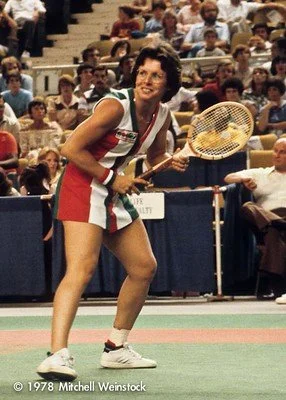
Billie Jean King in Phoenix, Arizona, 1978. Photograph by Mitchell Weinstock (qtschlepper) © Mitchell Weinstock. Licensed under CC BY-ND 2.0. Source: Flickr.
Everyone who has ever tried to do anything has experience with the uninvited one. At one time or another, we’ve had our vision, our touch, our discernment, our very breath stolen from us in plain sight. Pressure doesn’t discriminate. It shows up at the doorstep of the Little Leaguer as well as the All-Pro quarterback. It’s standing on the other side of the window waving at both the CEO and the stay-at-home parent. It hangs out anywhere and everywhere people care about what they do.
An equal opportunity provoker, it targets both the soaring and the stumbling. “Excellent. Do that again,” it taunts, “I dare you.” Then as if we need reminding when we serve a ball into the net, “You can’t do anything right.” It whispers in our ear and shouts in our face, daring us to spar…or run…or bury our head under halfway effort where it feels indiscriminately safe to hide. It tempts us to take our eye off the ball. “Look! Look at what’s about to happen.”
It’s so hard to not take the bait.
So where exactly is the privilege in all of that? Perhaps it lies in the freedom to stretch—the act that leads to internal and external expectation. Maybe it lies in the opportunity to express and expand ourselves. The word “privilege,” in its Latin roots, means “a law for one person.” Though it’s morphed over time to carry the connotation of a special right or immunity, original contextual definitions infer neutrality. Privilege could be an advantage or a disadvantage depending on a person’s law.
How you see it, how you don’t is an individual deal.
What if we turned our thinking around? What if we put the words in inverse order? What if we got insanely curious about what Billie Jean’s quote might mean? If we allow ourselves the privilege, we get the pressure. When looked at through that lens, we gain a friend and not a foe. A partner who while keeping us humble makes us better.
That might restore the blood flow. It might turn off the Times Square ticker making rounds inside our heads. It might revive the joy.
P.S. Pressure