
Shooting Star
In honor of Father’s Day, an excerpt from my first book, Rooted to Rise...
My PaPa was a funny man. I write his name with two capital Ps because he wasn’t a Papa, as in a distinguished father figure from a period novel. He was a Paw Paw-- as in a small-town southern grandfather who would snatch your nose with sleight of hand, show it to you between his fingers, and then stick it back on the front of your face. That’s how he said “Hello” and “I love you” and “Life is really good today, no matter what you might be thinking at this particular moment in time.”
He whistled while he worked and while he didn’t. He thumped high school boys on the back of the head, bought my brother and me potato chips and comic books at the local drugstore, and sat beside my Granny Sunday mornings at church. He was my hero before I realized what a hero was. And he was funny. I don’t know if I’ve ever known anyone who loved to laugh more than him.
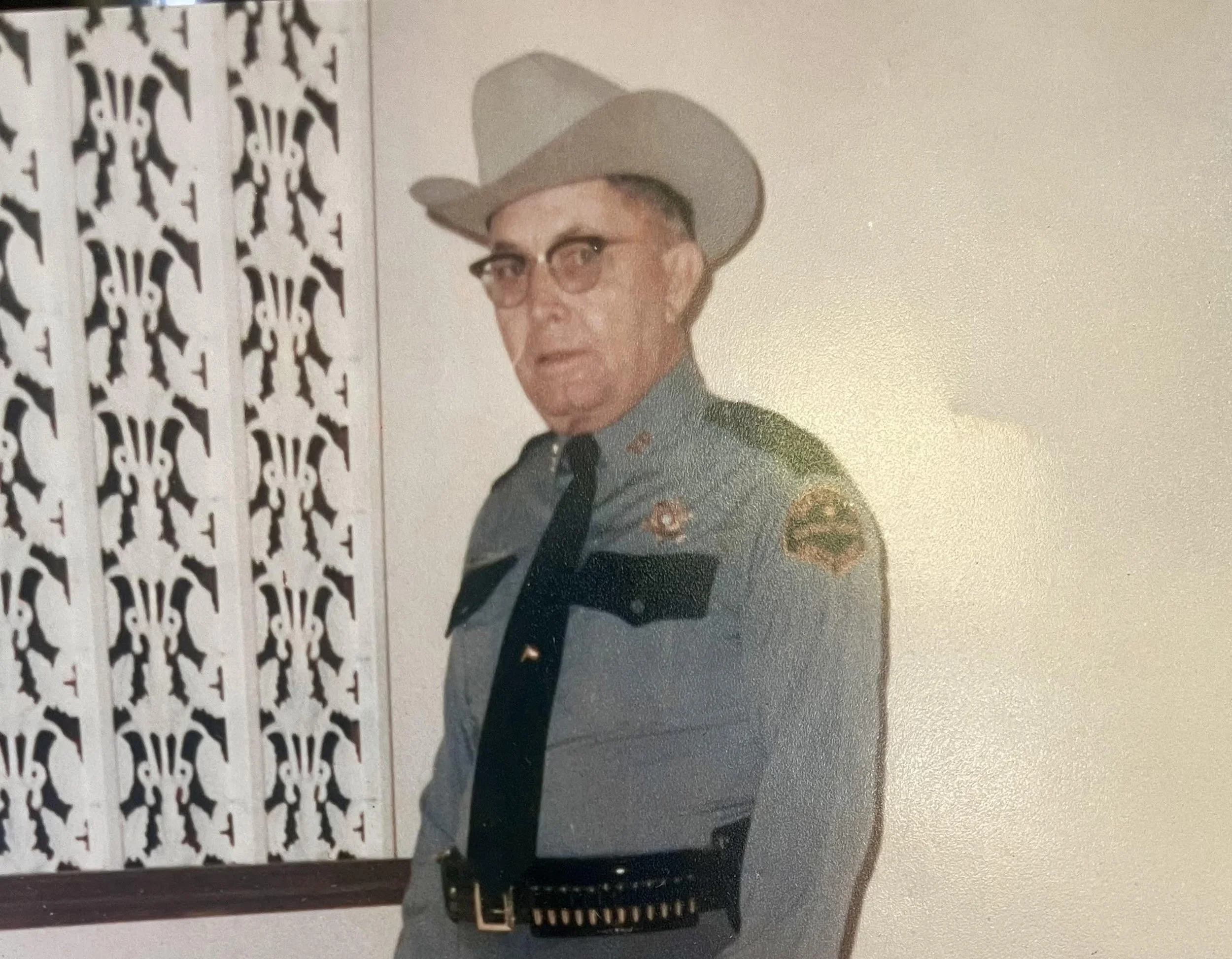
PaPa was a county deputy sheriff. Before that, he and Granny owned a mom-and-pop grocery store on Sinclair Street in Healdton. Before that, he was a farmer. But all I remember him as was a man who wore a badge. I know he had a closet full of clothes, but I can’t see him in my mind’s eye in anything other than his perfectly pressed grays with a star pinned on his chest. Every morning he strapped on the shiny black-patent gun belt lined with bullets and a pearl-handled pistol. He’d don his cowboy hat—felt in the winter and straw in the summer—and head out to make his rounds. The drugstore for coffee, the Dairy Queen parking lot for speed patrol, the “Y” at Hwy 70 for presence. PaPa didn’t just do his job, he lived it. Everybody for miles around was glad he did.
Deputy cars come in all kinds of shapes and sizes. PaPa’s office on wheels was a four-door Pontiac with star decals on the side that he drove like a snail up and down the streets of our sleepy rural town. Hurry wasn’t a word he used, listened to, abided by, or even appeared to understand. He had a pace. He had a routine. He got there when he got there, which in retrospect seems like an Achilles’ heel for an officer of the law. Yet, steady and sure worked way better than fast for him. He was as predictable as the tick of a clock—except when he wasn’t. That dichotomy made him real and rich and a shooting star of a man, even though that was never in a million years what he was trying to be.
Well before I was old enough to apply for my driver’s license, I learned how to drive in PaPa’s “police car.” We’d go out on the red-dirt back roads of Carter County, where he’d get out of the car and amble around to the passenger side while I’d dead sprint and slide around the corners of the rear bumper to get to the driver’s side left-open door and climb in behind the wheel. (I’m not sure if I thought we were going to get caught or if I was afraid he might change his mind or if I was terrified the car would take off on its own before I got there, but I vividly remember my heart and feet racing to secure the spot.) And then he’d tell me nothing. Nothing. With the scanner radio blaring charged chatter, I’d slip that Pontiac into gear like I’d seen PaPa do hundreds of times, and I’d figure it out. I loved to drive and he loved to let me. The days and the chug-holed roads taught me how. Driving was just one of the many things PaPa pointed at with his chin to help me learn.
PaPa had a few robust friendships and a million sanguine acquaintances. And he had a nickname for almost everybody. If you were “Goober Tom,” you knew he liked you. If you were “Knothead,” you knew you were doing something dumb. He weaved in and out of behavior-shaping with a layman’s genius, using language and laughter like a skilled artisan. PaPa nudged in the borders, like a collie herding cows, making better people at every turn.
One of the pleasures of his position was the requirement to attend area high school sporting events—especially the emotionally charged rivalry games. He’d stand in the baseline corner of a sardine-packed gym, or slowly roam the deep end zone of an overflowing football field, and people would just behave better. While I’m certain the pearl-handled pistol at his waist had something to do with that, it wasn’t so much the outfit as the way he wore it that kept the peace. Stationed beside his hip, I watched overtimes and flying dunks and touchdown dances and lobby fights. I saw the good, the bad, the ugly, the raw. I watched him work the shadows so those dancing in the lights could have their time. Hanging out with him was like scoring the golden Easter egg: I got to see both who and what I wanted to be when I grew up.
PaPa caught my softball pitches barehanded, rarely flinching no matter how hard I threw. He’d hit me pop flies and grounders, and he was always leaning on the fence just beyond the finish line of my quarter miles. He never told me to get outside and practice. He didn’t coach my Little League teams. He didn’t break down the game when I got home. But he loved to watch me play. Especially basketball. Even then it seemed he sensed what made my heart beat best.
Mostly, I walked to and from the gym that was only a couple of blocks from Granny and PaPa’s house to practice basketball on my own. But sometimes, if it was getting dark or raining, PaPa would show up to give me a ride home. I never told him when I was going—we didn’t keep a schedule on the wall. He just had a way of being there whether I knew I needed him or not. Nobody maneuvered the periphery quite like him.
The only time I remember PaPa ever saying anything to me—good or bad—about how I played the game, was after one late-evening workout. A workout that consisted of me, a couple of balls, and an otherwise empty gym. The spot’s still tender where his arrow stuck. It’s funny—funny odd, not funny haha—how looking back, I can’t remember his words at all. I think he asked me a question, though I’m really not sure. And I’m super fuzzy on how I answered it if he did. Maybe I didn’t—not out loud, anyway—but I still feel the point. Go to the gym to get better, or don’t go at all. I’d been going through the motions and I knew it. Apparently so did he. No emotion, no judgment, no punishment to serve, just a well-aimed truth to the bullseye of my soul.
My precious PaPa died when I was a freshman in high school. He got sick fast and got bad faster. We came home from school, and the back door of the house was locked. We went to see him at Healdton Hospital. Then Ardmore Memorial Hospital. Each stay was brief and folded into the next at a more comprehensive spot. Within days, he was transferred to Mercy Hospital in Oklahoma City, where the room was pretty, quiet, and full of impending doom. I’ve visited hundreds of people at Mercy Hospital through the years, and it still hurts when I walk in the door. Loss is like that, I guess. The threshold never really heals entirely, even though you grow second skin all around it. Mercy Hospital’s seventh floor is the last place I held his hand.
PaPa’s passing kept tossing out lessons, just as his life had. I remember my mom’s staunch bravery and her willingness to cry and admit how lost she felt saying goodbye to her Daddy. She was so elegantly brave that I assumed all who lost did so with grace and transparency. Now I know I was wrong. But what I saw in her was what he gave her: the strength to sit in grief and feel it, and then let it prompt her when it was time to move on.
I also remember my Granny’s intense sadness, and what I learned from him through her as well. I remember asking Mom if Granny would ever be happy again. I was terrified this joyful hero of mine would forever and always be sad. Sitting on the blue and yellow flowered bedspread of Granny and PaPa’s room, my mom said, “Yes, she’ll be happy, but she probably won’t ever be the same.” That dart of truth scared me and emboldened me at the same time. That’s when I realized that happy is a string that stretches through you, and when people you love die, they take some of you with them as they go.
At the funeral home in the days following PaPa’s death, a steady stream of people passed through to pay their respects. There were extended family members, close friends, people from the community, brothers and sisters in Christ. But these streams were also dotted by people I had never seen. Some were dirty, some wore tattered clothes. Some had disheveled hair and smelled of alcohol. I was even scared of some. I didn’t know them, and I didn’t understand why they were there.
On the day of his service, the back three rows at the Shell Street Church of Christ were filled with those folks connecting the familiar. They lined up to see my Granny after the closing prayer. Some said PaPa had given them food when they didn’t have any; some said he had picked them up when they had no way to get where they needed to go; some said he had picked them up because they broke the law and that he’d handcuffed them and taken them to jail.
PaPa was an “all kinds of kinds” kind of guy. The lines he drew were straight, but the corners weren’t sharp. I suspect that’s why they all came to his celebration of life. He just had a way of stirring everything up—the good, the bad, the funny, the serious, the right, the wrong… he’d just knead it all with his big, strong hands, chuckle for a bit, and whistle as he went on his way. He could make good stuff out of anything. Maybe even me.
P.S. Daddy’s Hands
To purchase Rooted to Rise and discover more stories like this one, scan the QR code below.