
Sooner Magic
At the end of the opening scene of Apollo 13, astronaut Jim Lovell (played by Tom Hanks) is standing in his backyard looking up at the sky. With an outstretched fist, Lovell moves his thumb back-and-forth and back-and-forth in a now-I-see-you-now-I-don’t maneuver over the bright white orb in the midnight sky. He squishes his left eye as he stares, “They’re back inside now, looking up at us. Isn’t that somethin’?” he says to his wife Marilyn (played by Kathleen Quinlan.) She drops the trash bag she is carrying and stops her cleaning up.
“I bet Jenny Armstrong doesn’t get a wink of sleep tonight.”
Neil Armstrong has just completed a bouncy stroll across the moon.
What happens next, historically, we remember. Lovell gets called up from the rocket-pilot bullpen to serve as the commander of the Apollo 13 mission. Things go awry in flight . . .the crew is running out of oxygen . . . a group of mathematicians in Houston devises a potential way to get them home before it does . . .the astronauts follow ground-control instructions and play build-a-bear inside the capsule. Then they splash down in the South Pacific.
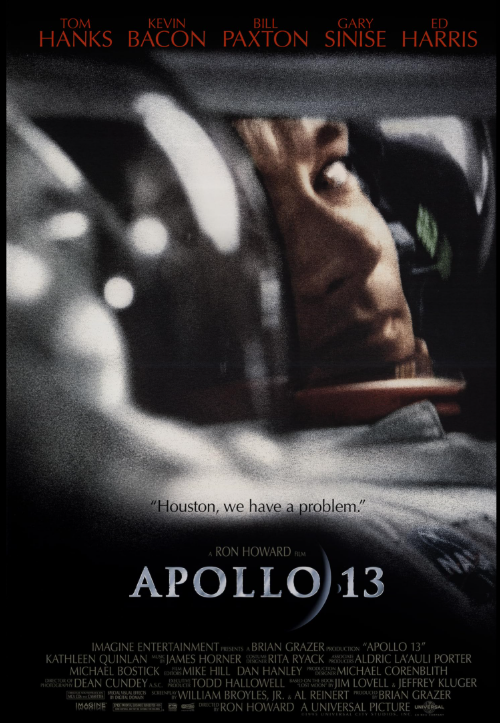
Apollo 13 theatrical poster. © Universal Pictures / Imagine Entertainment. Used here for commentary and identification purposes. Source: IMDb.
An inexplicable miracle. Sooner rather than later.
We remember the events vividly, as if we watched them on our smartphones as they happened. But it was 1970. We couldn’t and we didn’t. It seems now as if we had a front row seat because Ron Howard made it into a film.
For years, I used the movie’s early dialogue with my team as we set our sights on an upcoming season:
Marilyn Lovell: "You're telling me you don't think it's a miracle?"
Jim Lovell: "From now on, we live in a world where man has walked on the moon. And it's not a miracle. We just decided to go."
Decisions shape the trajectory of our lives.
In Oklahoma, when a team comes from behind to win, we call it Sooner Magic. The term was born on November 26, 1976, on the frozen tundra in Lincoln, Nebraska. Trailing 17-13 in the fourth quarter, Oklahoma (a smash-mouth ground-attack offense) ran a half-back pass from Woodie Shepherd to Steve Rhodes to get the ball deep in Nebraska territory. Then looking a 3rd-and-20 situation in the eye, they inserted back-up quarterback Dean Blevins to run the hook-and-ladder to get it to the two. With thirty-eight seconds on the clock, Elvis Peacock punched it in.
Sooner Magic is what happens when what happens doesn’t seem as if it should.
Oklahoma has its share.
In real life in 1970, two floors below NASA’s Houston Control Center, a team of IBM mathematicians headed by David Proctor were called upon to figure out a way to get the crew of Apollo 13 home. They had just hours to come up with a plan that would typically take weeks and weeks of research and calculations to design. Proctor admits he wasn’t certain it would work. “I hoped and prayed,” he said. “Then prayed some more, and made a deal or two with God.” The “slingshot” method ultimately decided upon utilized the Lunar Module’s engine to fling the spacecraft around the far side of the moon and back to Earth where the world was holding its breath as it waited.
David Proctor, team critical-math-trajectory leader and eventual recipient of the Presidential Medal of Freedom is a graduate of the University of Oklahoma. The Aquarius Lunar Module that served as the “lifeboat” during the harrowing return trip of Apollo 13, was piloted by Fred Haise, graduate of the University of Oklahoma. Gene Kranz, the lead NASA flight director, was played by Ed Harris who studied drama at the University of Oklahoma, his father’s alma mater. Parents of Ron Howard, who brought the hard-to-believe story to the big screen, are graduates of the University of Oklahoma.
We call this Sooner Magic, too.
Marilyn Lovell might have been right. A man on the moon might not be a miracle. It might be as simple as Jim said it was. A decision.
Magic is usually a whole lot of both.