
Eye Conflict
You send a cutter through. That’s how you can tell, in basketball, if the defense is in a man-to-man or a zone. The same test is used in football when a guy in the backfield is sent in motion while the quarterback stands over center barking numbers into the wind. The movement is designed to force the defense to declare.
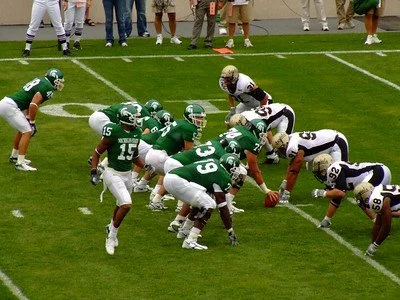
Photo: “Man in Motion” by Alex (aldoty85), via Flickr. Licensed under CC BY-NC-ND 2.0.
A tick of hesitation can give the offense a window for gaining an advantage. A step here, a hedge there, a shoulder shift, a head turn—the smallest action (or inaction!) can break a possession open wide. Offensive maneuvering, though not foolproof, puts the onus on the defense to communicate, while putting pressure on the speed and timing of their plan. But mostly initial action gives the defenders compelling data to process. Hard-to-guard offenses don’t necessarily coerce the defense into making a mistake; they simply offer all sorts of things for defenders to take into consideration. Individual commitment, then, sits at the crossroads of a brain with a bevy of open doors.
The question is, “How do you decide what to do about what you see?”
Great defenders can’t ignore everything except their primary key. They need to ingest enough peripheral information to understand what’s developing while refusing to let irrelevant information hijack their attention. While the offense is intentionally trying to make the unimportant look important, some of what it does carries consequence. If all ignore a basket cutter, the ball will find her and she’ll score.
We act, sometimes, as if all distraction is frivolous. Put down the phone, ignore the noise, keep your eyes on the goal. But the tough—perhaps integral—decisions are not typically between significant and insignificant happenings. They’re between the vital and the vitaler. When several things legitimately warrant our attention—the kids, a hospitalized parent, a dwindling bank account, the cars speeding by on the left and merging without blinkers from the right—how do we decide what to do?
The quandary is the conflict placed on our eyes.
Goethe advised us to not let trivial tasks override those of irreplaceable value. “Things which matter most must never be at the mercy of things which matter least,” he said. Got it. Easy peasy. (Well, maybe not easy peasy to do, but definitely not tough to understand.) His dependable schematic is helpful for a cup that’s running over. On the subject of crucial vs. crucial, however, the German polymath seemed to be mute. When two or more essentials co-exist, which gets gifted the nod?
It’s hard to say.
Linebackers and safeties lean on systems. They have “if-then” scenarios. If the offense does this, then I do that. The system prevents urgency from kidnapping judgment. In basketball, man defenders deny a cutter all the way through, while zone defenders hand her off at boundary lines. Rules regarding areas and priority sequencing reduce the number of decisions a defender has to make on the fly. But ultimately the weight of action lands on the person standing where competing responsibilities intersect.
What matters and what matters more and most are sometimes part and parcel. What we attend to first is not a discernment of worth but of order.
We do what we can with what we have.
P.S. You’ve Got Prayers