
I Thought This Happened Everywhere
The shiny black hearse is the tip of the serpentine spear. Behind it, car after car after truck, truck, truck after car after car after car follows, each with headlights bright in the fullness of day, some with hazards blinking as if to clear their eyes or signify importance. Connected by heavy invisible hoses, coupled vehicles slink along, sometimes with no end in sight, managing the stress of pulling and turning. Yeoman’s work of carrying on. The train helps to dispense the weight.
In Oklahoma, oncoming traffic pulls to the side of the road to pay respect.
It’s not the law, but everybody does it here.
Where the processional occurs – a back street, a main street, a highway—is immaterial. It doesn’t matter that adjacent drivers don’t know where the mourners are coming from or going to, if the life that’s being honored was a ninety-year-old well-worn wick or a flame barely lit burned out. It doesn’t matter if you’re late or in a hurry, if the slithering line is ten cars or a hundred-fifty. If you are driving and you can see the crawling convoy, you slow your car, steer as near to the edge of the road as you can, and stop. And you stay there, still as a stone, until the very last passenger carriage has passed.
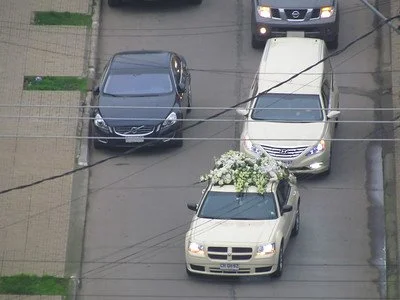
It’s what we do, I suppose, because it’s what we can.
As my friend and I sat idling on the side of the road bumper to bumper with other locals while a meandering motorcade inched its way by, an SUV with Colorado plates decelerated quickly in the inside lane, conforming, perhaps, to the pressure of its peers. My friend was flummoxed. An east-coast lifer, she found the tribute impressive but extremely odd.
I thought this happened everywhere.
Shared suffering is part of the concoction that glues great teams together. It’s also what binds families and schools, and communities and states—and nations, even-- though how quickly we forget. The willingness to wait with someone as they ache says, for just the tiniest slice of time, you matter more than me. And if you’re in one of the vehicles with a crumpled Kleenex in your palm and the radio dial turned to zero because you don’t have space for sound, it doesn’t go unnoticed, this breath a stranger holds for another stranger. Somehow the genteel gesture needles past survival armor pricking you in places the preacher couldn’t get to. A tiny act can help a leaking vein to cauterize.
All-hands-on-deck assists in healing, while, ironically, doing double duty. Helping inevitably helps helpers. This simple action connects us.
As the red light ahead turns green and nobody goes, for just a fraction of a second, the world seems less confusing. And we feel less alone. The grocery store, the bank, the dry cleaners, the meeting, the Bible study, the tee time, the movie--it all can wait.
Here, in Oklahoma, we still speak to strangers. We have standoffs at stop signs when none of the four of us can decide who yields or goes. Here, where green tornadoes play hopscotch across the land and you can see the stars from almost anywhere at night, it’s not safe on every corner. Nor does every car you pass return your wave. But most of them do.
And here, almost without exception, people pull over to honor a long line of somebodies saying good-bye to a somebody they won’t see again.
What a great place to be from.
P.S. My Okie Poking Out