
Waving Goodbye
My dad would have turned 89 yesterday had dementia not rooted in and crowded out his days. On his birthday, I ache for all the life that’s happened here without him.
Consistently, but with haphazard timing, his essence blankets me.
This story—my way, I suppose, of folding up and tucking away the raw edges of jagged grief—was the first blog I posted when I began “A Weigh of Life” almost five years ago. I’m re-posting it today with a little spit-shine, including a fresh title. Dad was big on buffing. I think he’d be glad to see I’ve moved forward from the arm of his chair.
The “way back when” is like a series of little movies. The day I tripped the brake on the golf cart while Dad was standing over his ball on number 13. The day we drove that shiny midnight blue Buick Regal off the lot and he taught me how to check the oil and work the jack. The day he walked me down the aisle, nervous as a cat, me in my veil, calming him and running the show as I suppose I have always been prone to do. But it’s weird. I don’t remember him at all from that day, past the aisle.
These mini-movies work like that. I do remember, clearly, him holding my firstborn. And the endless wrestling matches, Cowboys and Indians fights, and fishing escapades with both my kids. I remember the cartoon surprises that came in the mail personally addressed to each of them and the closed-lip grin that stretched with pride when they made a tackle or hit a ball or simply walked into the room. And then it kind of stops. My memory train, that is. There’s a hole in the middle.
The last six years are vivid. Gnarly and almost too hot to touch. But they are my treasure, still. The day it hit me –that he was gone and not coming back—I cleaned his house with a fury. Alongside me were my closest friends, not saying much, just cleaning and carrying and sorting. Yeoman’s work to tether me to what was left. And I’m not talking about the house on Jon Street.
In the marrow of the dripping days when I would sit with him, I would consciously think, “Sherri, please say something that matters. Draw him into conversation. Work harder to connect.” Then I would stare with him at the TV and surrender at the edge of my capability. Being there was the best I could do at the time.
But I do feel bad about the middle.
The middle was when I missed it. I was so busy raising my kids and working my job and living my life that I failed to pay enough attention. Weekly phone calls were blurs. When he wouldn’t answer, I would be frustrated instead of concerned. When we visited and he seemed disengaged, I secretly assumed he had given in to his inner cynic, that he had chosen to withdraw, that he wasn’t fighting for joy and purpose, as I, obviously, was. Self-righteousness is so easy to recognize in the rearview mirror. While he slipped, I was looking the other way.
From the day that we moved him into his new home away from home, all I ever wanted was for him not to feel scared, which is a really odd thing for an achiever to have as a beacon because despite anyone’s most valiant efforts, that‘s as difficult to measure as it is to control. But that was my pipe dream. That’s why and how my car drove to Brookdale Assisted Living Center and Walmart and the VA Hospital at all hours of the day and night. I never wanted my Dad to be lonely or in pain or angry. But mostly, I never wanted him to be scared.
Unfortunately, or maybe fortunately as I really think about it, I discovered that I didn’t have that power. No matter how hard I tried. The best I could do was make sure he felt loved.
I remember sitting beside him searching impossibly for some sort of divergent question to pose that would send something—anything-- back in my direction. For the last few years, trying to have conversation was like playing tennis without a partner. When you hit the ball over the net, it never came back. I would beat myself over the head incessantly—I was a teacher for God’s sake! Why couldn’t I come up with a good question? Surely something could elicit a response. But the harder I reached, the better the words hid. Over time, I simply surrendered to the silence, crossing my fingers that love would fill the gaps.
I hope Dad knows how much I learned sitting by the arm of his chair.
Parents teach in all kinds of ways. Dad was never much of a lecturer or a philosopher--or really much of a talker at all. But he was a laugher. And a face maker. And a farter. And a goofball. So far from perfect, we won’t even go there. But I’m not so sure perfect is ever an admirable goal.
Dad did more than he said. He made forts and caves for my friends and me for weekend sleepovers, complete with hand-delivered popcorn and Hershey’s Kisses. He cooked legendary Saturday morning breakfasts and made every game I ever played or coached, if it was within his capability to get there. I tried hard on some of those silent visits at the Assisted Living Center to remember him ever congratulating me for scoring a lot of points or winning an important game, but I never could remember a time. The only thing I can clearly recall is that he always looked at me the same when the game was over. Then he’d grab me by the back of the neck with one hand and we’d go get a cheeseburger. While I cherish what he did, I equally value what he didn’t do.
Dementia is a painful disease—they say more painful for the loved ones than the patient, but I’m not sure I buy that. I looked in his eyes. The doctors said when he wasn’t eating and I was sure that he was hungry, that it was highly probable his brain didn’t even connect the two. I can get on that channel, but lucidity is so fluid. I can’t help but think there had to be seconds, every now and then, when a chili dog sounded like something he would trade breath for.
Nobody really seems to understand this skulking illness. It makes some people mean and others vile. It softens some and hardens others. It twists and torques the strongest and the weakest of its victims—there’s no predicting and even less explaining. It simply goes where it goes and takes the person we love with it. Luckily, I still saw chunks of vintage Dad down to his last days. I often thought, as his bones protruded, the muscles emaciated and the skin hanging like a veil, that he had more Rocky in him than the world ever knew. He just wore it in his own way.
The last few years were like an electrocardiogram. Things would blip along monotonously and then there would be a spike. Usually when I went out of town. You could almost set your watch to it. I would travel and I would get a call that he had fallen or there was an issue with his meds. It might be a jaunt for work, perhaps for play. I might be across the state; I might be across the world. But it was like he knew. In the beginning it made me so frustrated. After a while it made me mad. Then I turned predictably smug and expectant. (“I knew this would happen! It always does!”) My omniscience was arrogant and ugly, not to mention pathetic. A couple of years down the road, the whole scenario grew me grateful, because when I got the terror alert, I knew at least he was alive.
But the graph was always going. Blip blip blip then BAM! The BAMs, in retrospect, are so because they are burned into my brain like a brand. And many of them make me laugh. Like the time I couldn’t get him to let go of the walker to sit in his recliner. I would pry apart one grip and he would batten down the other, trapping my hand under his in the clutch. The cycle continued until my fingers were bruised and the back of my Sunday dress was soaked in sweat. This went on for a while. Finally, I leveraged my weight and chest-bumped him into the chair. With the walker’s legs parallel to the floor, positioned like the lion tamer’s stool, we locked eyes in stunned silence. Then we both began to giggle. The giggle grew into a laugh and the laugh into a howl that burped back up the rest of the morning every time we caught each other’s gaze.
Conversely, some of the BAMs make me cry. Like the time we were sitting in the Brookdale lobby listening to a talented young man strum the guitar while singing everything from funny folk songs to classic country. Though Dad couldn’t sing along, tap his foot or clap to show appreciation, his eyes smiled and danced as he held on tight to my hand. The BAM came with the finale. As the generous stranger played “Amazing Grace,” my non-communicative father mouthed every word. I’ll never forget it (until of course in similar uncontrollable throes, one day I might.) I sang until the words gummed up in my throat, then I tried to absorb the seconds like a sponge. In Oklahoma, they always ask you what you’ll grab to take with you if a tornado is coming; well, if that memory were a tangible thing, it would be what I’d clutch and run with.
The blips, however, really belonged to the nurses. I always felt like they gave him another life when he could no longer remember the one he used to have. If he had retained a decent level of health in his later years and lived at home, he would have never received the kind of slathering love and attention he got from this crew. (What an upside-down silver lining that is, ironically, true.) I fed him a lot-- from big spoons, in the beginning, that I had to wrestle away from him when he wanted to go too fast, then from strategically bent spoons when the highway from the bowl to the mouth got crooked, and then, finally, from the straws, first through his lips and then via the suction of my thumb. But they did it every day.
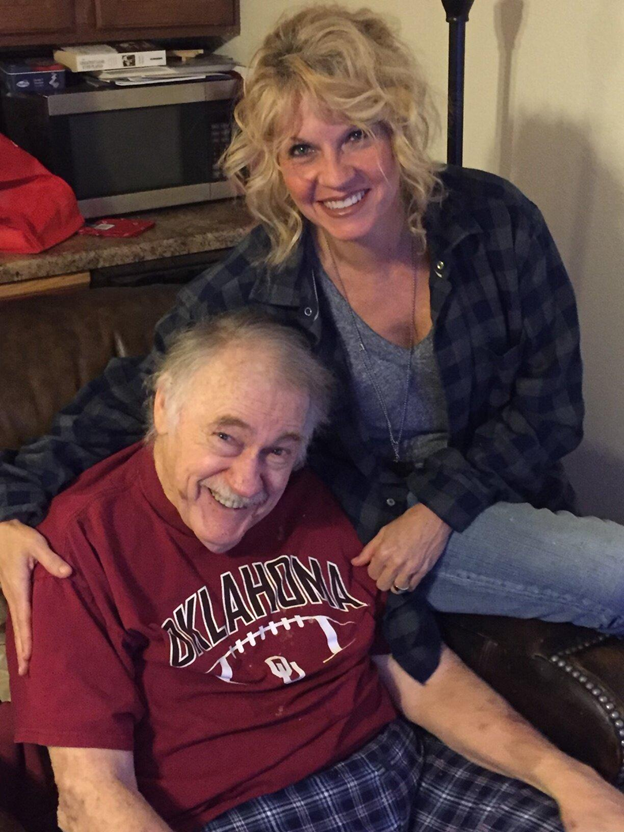
The Angels of the Blips.
I cut his hair and trimmed his mustache, but they cleaned and combed both with the regularity of a clock’s tick. They also did everything else that a daughter has a really hard time doing. And I never saw them do anything they did without love. He felt it, too. If I hadn’t been so grateful, I think I would have been jealous about the connection that they shared.
When Dad finally gave up the ghost, his whole family was around. Kids and their spouses, grandkids, friends that were like family, caretakers who loved him desperately. Everybody. Except for me. Wouldn’t you know it? I was in Phoenix for conference meetings. Go figure. But it went down exactly the way it was supposed to go down, the way he had been preparing me for all along. We’d had our time and he and I both knew I had always taken up too much room.
The night before he passed, my 21-year-old daughter slept in his hospital bed with him. I can only guess she did it because she loved him--and because she knows that’s what I would have done if I could have been there. And because she got his heart. One of my dearest friends stayed, too. She sat in the chair and snapped a picture of it all. Though it lives in my head, if a storm were coming, that snapshot would go in the tornado bag, too.
We had a service void of pomp and based on circumstance because that’s who Joe Buben was. He liked to slide in the side door and slip out the back. So we tried to celebrate his life in his fashion. We played the Platters in the beginning, “How Great is Our God” at the end, and “Amazing Grace” smack dab in the middle. My brother spoke like a champ, his words making those in the audience who didn’t know our Dad feel like they did, his poise and presence reflecting a father’s life well lived. Dad would have been in awe; and his face would have turned predictably red. I pictured him standing in the back with his hands in his pockets, chin down, eyes and lips smiling to beat the band. That’s how he looked when he was proud. He would have also wanted us to laugh and to find some things to make fun of, and he wouldn’t have wanted us to be there very long. So we got in and got out, hemming his thirty minutes tightly in prayer.
But the service is just the suturing. It’s what keeps you stitched together while you try to get on with things. That’s the tricky part.
My parents were divorced when I was really young, and though Dad never lived more than five minutes away from us when I was growing up, visiting him was what I did. So we said goodbye a lot. Then I went off to college, got married and had babies, and though the visits had more chunks of time in between them, they always ended the same: him standing in the front yard, waving goodbye.
He was never ready for me to leave but he always let me go.
I’m sure when our car drove out of sight, he did what I’m doing now: he tried to pick up the place. So much stuff is left lying around after the wave. I awkwardly mess with it now, like a crooked drawer you can’t quite get to close. And I laugh and cry in equal parts while I jiggle it. Just another thing I learned from my Dad.
P.S. Five More Minutes